 |
| Julie Chen 'Personal Paradigms' 2003 |
The April/May issue of American Craft Magazine has arrived and it contains a story on Julie Chen and her extraordinary books, 'Read Between the Lines'.
I then found
|
| Julie Chen 'Personal Paradigms' 2003 |

As we continue to use lines to divide ourselves into parts, we lose a sense of the whole. We tend to forget that even as lines divide, they also connect. While we so readily express our differences, let us also acknowledge our common humanity." (source: Kim Schmahmann)Since I first started to research quilts, I have had a problem with the use of the term, 'art quilt' to identify a separate category of layered and stitched textiles that fall within the broader category of quilts.


 |
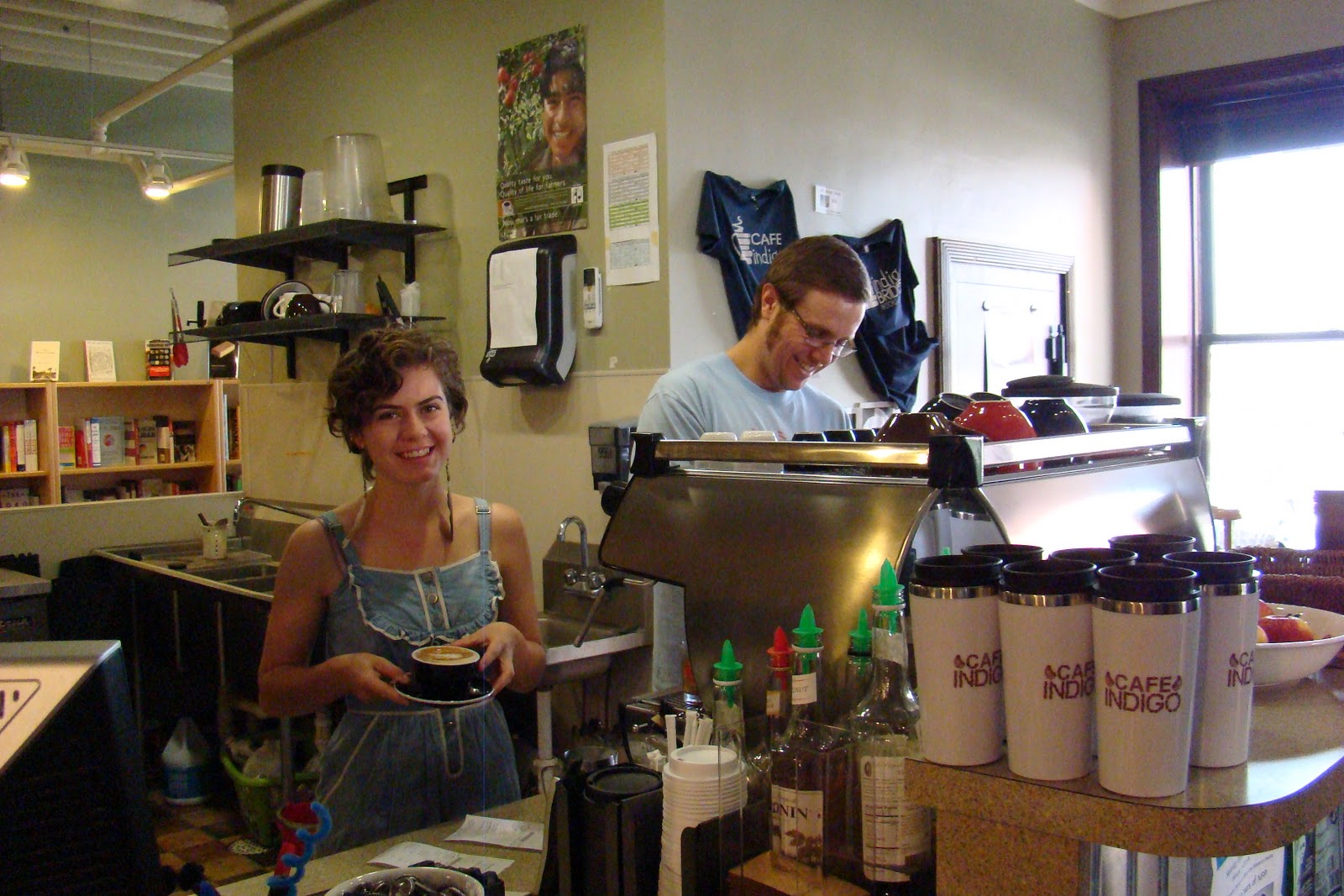
| Indigo Bridge Cafe & Bookshop (the best coffee in town) |
 |
| The Train Station, Lincoln Nebraska |
 |
| Postcard #3 (From Postcards from a Past'2003) by the author |
I can’t remember the sandpit but there is a photograph of me playing in it, left hand held high as I run towards the camera. Look at this, a daisy-chain, a fairy-chain, a strand of time.Mention sand and I think of another time years later. Lying on my back staring up into the night; the sound of waves in the dark stars above: stars upon stars upon stars drawing ever upwards dissolving boundaries pondering the possibility of endlessness. There are shapes and pattens within the constellations but I do not countenance identification it tells me nothing of the possibilities above me as I lie in the still-warm slight-damp sand. I struggle to comprehend impose meaning while considering the possibility none is possible.Infinity offers no explanation. It attempts to label the unnameable, beyond number beyond limit beyond being and by doing so ends up by limiting itself. It is labelling the known unknown (which in the act of naming must itself become known, it is the unknown unknown the other possibilities which lie beyond the horizon of knowing which draw me).The universe may be considered a fabric of reality knitted together in dark matter he tells me. The stars are visible points formed of light matter, dropped stitches within the dark cloth, loose networks of filaments stretching across time and space. Knit one purl one knit one purl one a binary code in repetition which shifts evolves in errors the hesitation dropped rhythm of stitch. Chaos theory string theory or loop quantum theory with space and time made of coiled ribbons, once tangled become particles. The many strands of time entangled enfolded envelope me.It is this repetition of stitch and not the single stitch itself which offers consolation. The knitted stitch, one needle through the stitch on the other, strand forward and looped around the needle, stitch pulled through. Knit stitch, purl stitch, increase, decrease, cast off but not the universe.
"Conscious thinking follows the rules of Greek logic--deduction, categorizing, inferring--our Western cultural heritage. [a form of 'striated space']. In contrast, unconscious thinking seems closer to free-ranging hypertext...where words and concepts are pursued to their most unexpected implications ['smooth space']. (p247--my emphases)The resulting text he points out, '...is a self-regenerating process'. Levensen then goes on to state:
I think the brain is individual but mind is a field phenomenon, a network, a web. (p250--my emphasis)It is that glimpse of possibility that the use of 'smooth space' can be helpful in generating new ways of seeing, new ways of hearing. An interactive 'cabinet of curiousity'


"Love's going to nail you to the cross/Love's going to nail you to the cross/It'll go right through you/It'll flatter and fool you/It'll do you good and nail you to the cross."And the quilt itself takes that message even further: it is the private made public, looking being made visible, the quilt can both reveal and conceal, it is reversible (the narratives to be understood from both sides), it enfolds. To work with Judy's quilts is to continually uncover alternative meaning, uncover new stories.

 |
| Bureau of Bureaucracy (1993-99) by Kim Schmahmann various wood veneers & hardwoods, mother of pearl, gold leaf & brass |

"We have become a planet filled with lines, lines that have become essential to our existence. We are so dependent on these lines we cannot imagine a world without them. We use lines to create countries, towns, time zones, production lines and deadlines. We live and die by these lines, and yet none of these lines exist except in our imaginations and through our actions. That is the power of lines.
As we continue to use lines to divide ourselves into parts, we lose a sense of the whole. We tend to forget that even as lines divide, they also connect. While we so readily express our differences, let us also acknowledge our common humanity." (source)Notes:
Louise Weaver: Melbourne-based artist Louise Weaver has responded to the Macquarie chest’s drawers and trays of taxidermied birds. Weaver’s drawer installation includes a native budgerigar, a zebra finch and a rainbow lorikeet, united by a wreath of wattle made from crocheted handblown-glass orbs. Weaver’s birds are ‘taxidermied from the outside’. Mummified in brightly coloured crotchet, they call into question our historical treatment of nature and our frenzied collecting and museumising.

"These patterns, and many of the others that emerged from the data [his research], suggest that (at least in our culture and in the present historical period) objects do not create order in the viewer's mind by embodying principles of visual order; they do so by helping the viewer struggle for the ordering of his or her own experience." (p36)This also leads on to a point I touched on in an earlier post. I believe the Lost birds series is different to other work by Pamela in certain ways:


Based on the Wunderkammer, its visual tropes, structural logic and reliance upon collection and display as navigational propositions, are from the first a knowing projection of the past into the present. However, the connections between the digital Wundernet and the Wunderkammer are meant to produce a gap, an interval, through which their constitutive difference enables us to make experimental, conceptual leaps in thinking. (p122)And what I am calling 'smooth space'...
 |
| Reconfiguring the Wall (2006) detail by Emma Riwden |


