Since each of us was several, there was quite a crowd. Here we have made use of everything that came within range, what was closest as well as fartherest away. (Deleuze & Guattari, in the introduction to A Thousand Plateaus, 3)

Friday, October 7, 2011

A Real Pretend Wagga for Paul Klee

At the opening f the TSA conference in October last year, an invitation was extended to the audience to propose quilts to be added to the collection of the International Quilt Study Centre & Museum. Earlier this year a submission was sent detailing three quilts by Judy McDermott in response to this invitation.

I am excited to report that IQSC have selected A Real Pretend Wagga for Paul Klee (1997) to be part of their collection:

Judy McDermott: A Real Pretend Wagga for Paul Klee (1997)
82 x 122 cm
Wool/acrylic and wool fabrics, machine pieced and hand quilted with hand-dyed silk thread
In Judy's own words:
This quilt is all about colour. What to do with the ferocious orange from the op shop? Add greens, as did Paul Klee in his colour studies. The yellow "makes the orange sing", says Johannes Itten, author of The Art of Colour. A wagga is a traditional Australian quilt or bush blanket made from wheat bags, old clothes, or found scrap materials. Many are cobbled together, although my favourite is 'sewn' with wire.    
(Artist's statement, Quilt National 1999)
Horizontal lines are present in a number of Judy's quilts--in the 'Big House' series as prison bars, in the 'Quilting Hill End ' series as picket fences that

Tuesday, April 19, 2011

The Velvet Highway - Blankets of Wisdom by Luciano Ghersi


I have started to subscribe to fiberQuarterly  an on-line journal from Canada. The first (or 'my' first) issue contains an article: 'Blankets of Wisdom' by Luciano Ghersi. It includes the following photograph, one which immediately attracted my attention:


The article can be read as a whole via the link above, so I won't attempt to summarise it here. 

It touches on the emotional and haptic connections to the blanket (the quilt) as do the images and patterns used.

Friday, April 15, 2011

Inspirations#1 Julie Chen's Artists' Books

Julie Chen
'Personal Paradigms'  2003


The April/May issue of American Craft Magazine has arrived and it contains a story on Julie Chen and her extraordinary books, 'Read Between the Lines'.

I then found

Wednesday, April 13, 2011

Setting up a blog

I spent a morning helping a friend to set up a blog to use in her travels and that has given me an idea for series of posts on our recent visit to Rajasthan (January 2011).

The trip was an intense one--we moved location 13 times in 19 days and it has taken me three months to find a way in to the multiplicity of experiences we had.

Thursday, February 10, 2011

A visit to 'Curious Colony'

Image from: When I grow up I want to be a forger (2010)
by
Joan Ross 

On Friday I visited the 'Curious Colony' exhibition now on at the SH Ervin Gallery until February 20. It was a review of this exhibition at the Newcastle Regional Art Gallery (10 July - 29 August 2010) that started me thinking about the Cabinet of Curiosities. I had missed seeing the exhibition in Newcastle but here was the opportunity to see the Newcastle Chest for myself, as well as the rest of the exhibition.
The Chest is fascinating, its contents as curious as should be, not only was I fascinated by

Wednesday, December 29, 2010

All Best Wishes for 2011!

Does the Art Quilt exist?

As we continue to use lines to divide ourselves into parts, we lose a sense of the whole. We tend to forget that even as lines divide, they also connect. While we so readily express our differences, let us also acknowledge our common humanity." (source: Kim Schmahmann)
Since I first started to research quilts, I have had a problem with the use of the term, 'art quilt' to identify a separate category of layered and stitched textiles that fall within the broader category of quilts.

As a starting point I would like to suggest that there is not such category and draw attention to  
two exhibitions at the International Quilt Study Center & Museum:  


  • Quilts In Common was the opening exhibition for the IQSC in 2008. As the curators It took a unique approach to the quilts by making connections between the various quilts in terms of individual marks, design, shape, technique, symbolism and by displaying the quilts alongside other objects

  • The second was  South Asian Seams, an exhibition of quilts from India, Pakistan and Bangladesh.  I had the opportunity to see this exhibition for myself at the Textile Society of America conference in Lincoln, Nebraska this October--the quilts were vibrant and completely in context within the gallery context.  


I intend to explore this issue in future Posts--and would appreciate any comments on the topic!


Thursday, December 9, 2010

Evolution or Revolution?

A friend asked if I'd seen the program Virtual Revolution, aired recently on the ABC. I hadn't and she sent me the link. It looks very interesting. I shall be exploring it in more detail (and there's innovative ways of doing this on the website, it's called the 3-D Explorer).

Monday, November 15, 2010

A flying lesson


A Frogmouth owl mother and her chick have taken up residence on the tree outside my studio window. As I started taking these photographs,  the adult started bobbing and stretching first one wing then the other then, to our amazement, the chick mimicked the adult's movements. 
Could this be the first lesson in learning to fly?

As I write I can see the adult owl still sitting within the crook of the tree. It is pouring with rain.

We have a number of owls in our area: the Boobook, Frogmouth, Powerful, Barking and even a Sooty Owl which perched outside the dining room window one November night. Generally we recognize each by their call: the Boobook with its two syllables which make up its name, the Frogmouth's meditative 'oom' , the Sooty Owl's descending whistle. Most often the call of the Barking Owl is also linked to its name and is something between a cough and a dog's bark, then at others ti can be can be altogether different.

One night I awoke to such a scream of such terror, I was convinced murder was taking place beneath my window.

Wednesday, October 27, 2010

Quilted Out Of Space: Postcards from Lincoln

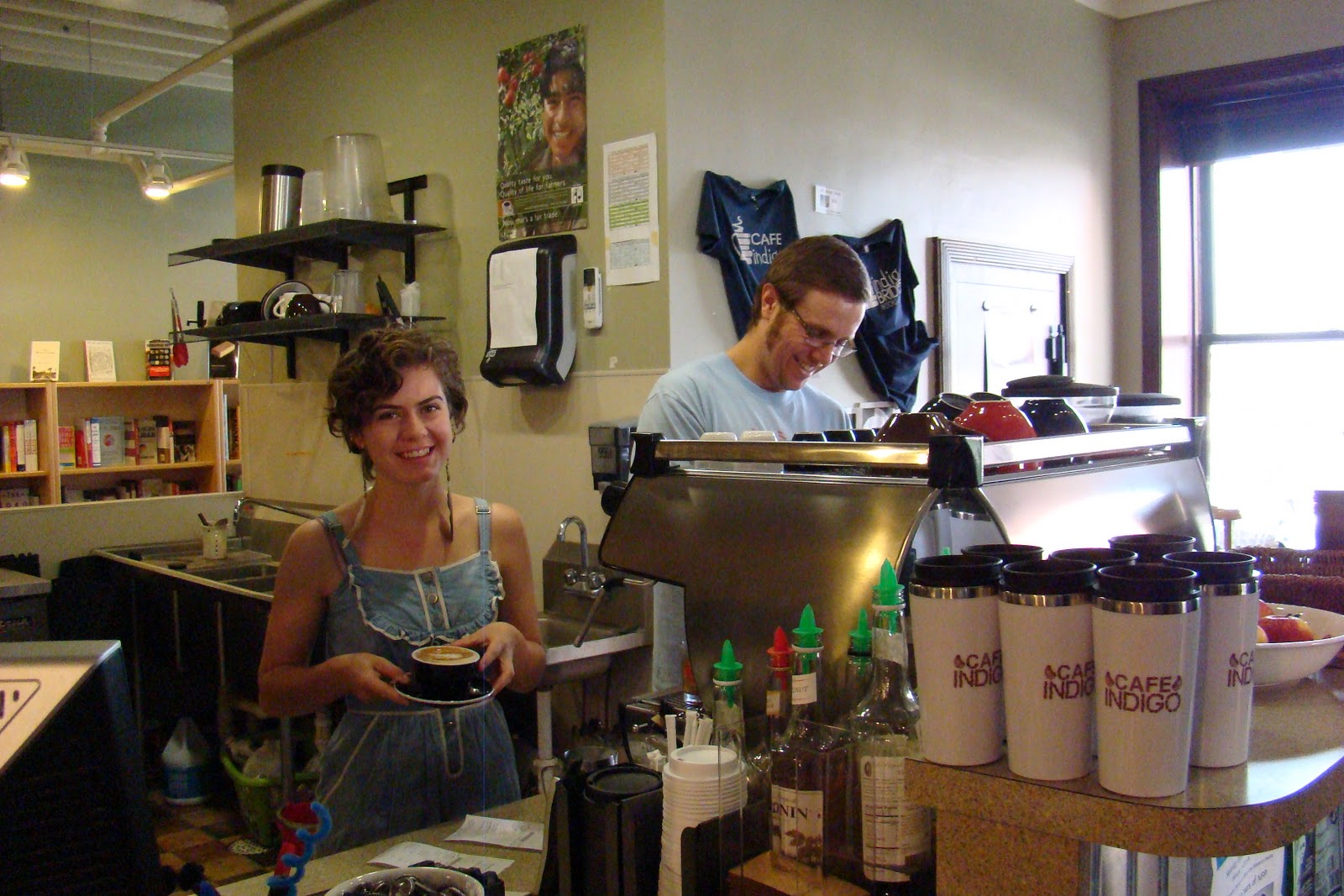
Quilted Out Of Space: Postcards from Lincoln : first some images--we intentionally arrived four days before the conference started and spent our time walking around the streets of Lincoln getting a feel for the place. Our focus each days (and all the days we were there) was the train station. The long goods trains were continually passing through, travelling slowly and sounding their low mournful horn (day and night). We also soon discovered and frequented the 'Indigo Bridge Cafe'--the best coffee in town! Also a bookshop and staffed by students, it also has a fantastic atmosphere.

Postcards from Lincoln

Indigo Bridge Cafe & Bookshop
(the best coffee in town)
The Train Station, Lincoln Nebraska


Wednesday, September 22, 2010

'On' and 'another' matter

Postcard #3
(From Postcards from a Past'2003)
by the author


I can’t remember the sandpit but there is a photograph of me playing in it, left hand held high as I run towards the camera. Look at this, a daisy-chain, a fairy-chain, a strand of time.
Mention sand and I think of another time years later. Lying on my back staring up into the night; the sound of waves in the dark stars above: stars upon stars upon stars drawing ever upwards dissolving boundaries pondering the possibility of endlessness. There are shapes and pattens within the constellations but I do not countenance identification it tells me nothing of the possibilities above me as I lie in the still-warm slight-damp sand. I struggle to comprehend impose meaning while considering the possibility none is possible.
Infinity offers no explanation. It attempts to label the unnameable, beyond number beyond limit beyond being and by doing so ends up by limiting itself. It is labelling the known unknown (which in the act of naming must itself become known, it is the unknown unknown the other possibilities which lie beyond the horizon of knowing which draw me). 
The universe may be considered a fabric of reality knitted together in dark matter he tells me. The stars are visible points formed of light matter, dropped stitches within the dark cloth, loose networks of filaments stretching across time and space. Knit one purl one knit one purl one a binary code in repetition which shifts evolves in errors the hesitation dropped rhythm of stitch. Chaos theory string theory or loop quantum theory with space and time made of coiled ribbons, once tangled become particles. The many strands of time entangled enfolded envelope me.
It is this repetition of stitch and not the single stitch itself which offers consolation. The knitted stitch, one needle through the stitch on the other, strand forward and looped around the needle, stitch pulled through. Knit stitch, purl stitch, increase, decrease, cast off but not the universe.
(From 26 Object Project, 2008)

The arrival of Edgar Levensen's paper, 'The Enigma of the Unconscious' (2001) last Wednesday provided that leap of understanding that perhaps, just perhaps, the questions I had been asking early in this project about 'space' and within that the void and more recently the workings of 'smooth' space could be answered by the notion of  'hyperspace'. 
Levensen's paper is about the unconscious, and the role of the analyst in the process of treatment yet I believe he manages to open up all sorts of intriguing ideas which include D&G's concept of 'smooth space'. He states;
"Conscious thinking follows the rules of Greek logic--deduction, categorizing, inferring--our Western cultural heritage. [a form of 'striated space']. In contrast, unconscious thinking seems closer to free-ranging hypertext...where words and concepts are pursued to their most unexpected implications ['smooth space']. (p247--my emphases) 
The resulting text he points out, '...is a self-regenerating process'. Levensen then goes on to state:
 I think the brain is individual but mind is a field phenomenon, a network, a web. (p250--my emphasis)
It is that glimpse of possibility that the use of 'smooth space' can be helpful in generating new ways of seeing, new ways of hearing. An interactive 'cabinet of curiousity'

Friday, September 10, 2010

It's midnight in the garden


Midnight in the Garden of Academe (2004)
by
Judy McDermott
102 x 76 cm
Silk. Cotton Batting. Machine quilted with cotton thread.
Knots are hand-dyed silk.

Completed in 2004, Midnight in the Garden of Academe was exhibited first in the US and then in Germany after Judy's death in 2005. I didn't have the opportunity to discuss this quilt with Judy but her husband told me that just as A Real Pretend Wagga for Paul Klee (1998)--selected for 'Quilt National' in 1999--was all about 'colour', Midnight in the Garden of Academe was all about 'texture'.


 (detail)

The titles of Judy's works are important, even if it is  now up to us to decode them the best way we can. She loved language--puns, double meanings, to cross-reference her quilts to poetry, to literature. Some, like Clap Hands Here Comes Charlie (2002) were named after a song title which she told me she had heard on the radio after the song itself had been played...Judy's daughter explained that Love Will Nail You to the Cross (1995-1997) was also named after a song: 'Nail You to the Cross' by John Ewbank. I have a recording of Jeannie Lewis  made in 1995 ('Tango Australis', Sole Music). The words and music are powerful, the message hard-hitting, it's message of inevitability: 
"Love's going to nail you to the cross/Love's going to nail you to the cross/It'll go right through you/It'll flatter and fool you/It'll do you good and nail you to the cross."
And the quilt itself takes that message even further: it is the private made public, looking being made visible, the quilt can both reveal and conceal, it is reversible (the narratives to be understood from both sides), it enfolds. To work with Judy's quilts is to continually uncover alternative meaning, uncover new stories.

The art quilt as a medium of expression draws on the tradition of the utilitarian quilt and, as such, is associated with home and family. Placing the quilt within the gallery allows these conventional narratives to be re-assessed and the opportunity for other, even 'hidden' meanings to emerge.

Wednesday, September 8, 2010

Wonder (4): connections--the cabinet, the blog

Bureau of Bureaucracy (1993-99)
by
Kim  Schmahmann
various wood veneers & hardwoods, mother of pearl,
gold leaf & brass

I saw this cabinet of curiosities ('...of Bureaucracy') in the Renwick Gallery Washington DC  when I visited in 2007.

Made by Kim Schmahmann, the workmanship is exquisite, personal yet universal--the lower drawers contain Schmahmann's birth certificate, marriage certificate and death certificate (not yet filled out).


(detail)

The more I think about it, the more connections I can find between such cabinets, the blog and the quilts. And returning to the Macquarie Chest, these become quite specific:
  • Lost birds: the bird depicted (or 'noticeably' absent) from this series of small quilts is the Glossy Black Cockatoo. These are becoming increasing uncommon due to the felling of their food source, the casuarina (she-oak, or Botany Bay wood) tree. Identified by the early colonists as being particularly good for making furniture, it was used to make a number of the early cabinets used to store scientific collections. The Macquarie Chest, however, is made from Australian Red Cedar and Australian Rosewood (rose mahogany) both found in the Lower Hunter district (of NSW) but now quite uncommon due to their early popularity. The Red Cedar and Turpentine trees on the property where Pamela now lives was felled in the late nineteenth and early twentieth centuries. The logs were brought out along snig tracks that form the basis of many of the walkways today.
  • It was the convicts, transported from England, who worked the lumber yards in the early days of the colony, among these were cabinet-makers who also took on private commissions such as the Macquarie Chest.  (A connection to the 'Big House' series).
  • The Callan Park estate was first settled by John Ryan Brenan who arrived in Sydney in 1834, only thirteen  years after Macquarie's time as Governor of NSW ended.
  • It is their 'secret' histories that make these objects so intriguing--the personal details of the collector's life, the reasons behind the selections that make up the collection and, what has happened to the object in the years since. Each of these quilts bring to light histories of various kinds--of a particular site (the Gorge, Callan Park), of the 'others' in society (the mentally ill, those who have broken the law) and even the quilt itself, too often overlooked as a medium of personal expression and work of art.  
As I write this and search for even more connections (feeling certain there are some). I realise the obvious-- it is not the works themselves which are making the connections but my own mind. Just I choose the individual pieces of cloth to make a quilt, I am making connections and putting together stories that link the three quilts which make up this project. Thus a 'cabinet of curiosities' can be a metaphor for the mind, and this blog becomes a reflection of the way mine works...a performance of 'smooth thinking' (see my Post, 'Smooth Thought' dated January 19 this year). 

When I looked around Kim Schmahmann's website, I noticed the following statement and perhaps I shall use it as an epigraph to this project:
"We have become a planet filled with lines, lines that have become essential to our existence. We are so dependent on these lines we cannot imagine a world without them. We use lines to create countries, towns, time zones, production lines and deadlines. We live and die by these lines, and yet none of these lines exist except in our imaginations and through our actions. That is the power of lines.
As we continue to use lines to divide ourselves into parts, we lose a sense of the whole. We tend to forget that even as lines divide, they also connect. While we so readily express our differences, let us also acknowledge our common humanity." (source)
Notes:
Elizabeth Ellis, 'Rare & Curious'--for details of the Macquarie Chest

Thursday, September 2, 2010

Wonder (3)--a response & more thoughts


I'm writing this in response to Ruth's comments to my Post, 'Wunderkammer/Wundernet' (August 28). Ruth asked certain questions which have helped me clarify my thoughts and the reasons why I made the link between Pamela's Lost birds series and the wunderkammer/cabinet of curiosities and here are some of my answers:
  • When I opened the 'Spectrum' section of the week-end Sydney Morning Herald at John McDonald's review of Curious Colony, it was the image of the open Newcastle Chest that caught my eye--in the centre of which was Louise Weaver's Area (2010):
Louise Weaver: Melbourne-based artist Louise Weaver has responded to the Macquarie chest’s drawers and trays of taxidermied birds. Weaver’s drawer installation includes a native budgerigar, a zebra finch and a rainbow lorikeet, united by a wreath of wattle made from crocheted handblown-glass orbs. Weaver’s birds are ‘taxidermied from the outside’. Mummified in brightly coloured crotchet, they call into question our historical treatment of nature and our frenzied collecting and museumising.

 Louise Weaver Arena 2010


Louise Weaver Arena 2010

hand-crocheted lambswool over taxidermied
zebra finch (Poephila guttata), budgerigar
(Melopsittacus undulatus), rainbow lorikeet
(Trichoglossus haematodus), hand-blown glass,
wooden beads, cotton embroidery thread, gold
leaf and mono filament, 8.2 x 47.0 x 36.0 cm
Photography by Mark Ashkanasy
courtesy the artist and Darren Knight Gallery, Sydney

[Image and text down loaded from the Newcastle Regional Art Gallery's website, 1/9/2010]


  • That 'leap of connection with Pamela's Lost birds series was initially probably figurative, a visual connection with the subject matter (birds) but then I believe it goes deeper than that--it's that sense of the 'unexpected'and 'wonder' that I feel with both Pamela's and Louise Weaver's works
  • And yes, the wunderkammer as an object intrigues me too, that sense of discovery. And yet I also associate it with a sense of 'loss'--and this is where early memories come in
  • Memories of the museums from my childhood...the taxidermied animals, often rare, sometimes extinct; various bits and pieces, sometimes whole organisms, preserved in formaldehyde, the fusty bottles/jars carefully labelled in copper script handwriting. These museums were very different from the museums of today, they often had poor lighting and crowded shelves [I had already made this connection when I asked Pamela if I could use her Lost Birds in this project]
  • my own boxes of objects precious--related through their perceived value to me personally rather than to each other. And as Helmut Lueckenhausen (quoting Milhaly Csikszentmihalyi) points out:
"These patterns, and many of the others that emerged from the data [his research], suggest that (at least in our culture and in the present historical period) objects do not create order in the viewer's mind by embodying principles of visual order; they do so by helping the viewer struggle for the ordering of his or her own experience." (p36)
This also leads on to a point I touched on in an earlier post. I believe the Lost birds series is different to other work by Pamela in certain ways:

  • it contains figurative references (albeit silhouettes, chalk outlines of a body at the scene of a crime) 
  • while it, as her other work, is linked to a profound sense of place  (the Bow Wow Gorge) and the process of time, it is a of a more recent 'time' (even to the present, the glossy black cockatoo is still around, if uncommon) than many of her other works which reference the Permian, a period in the earth's history 245-360 million years ago . It connects to the scientific work Pamela does as a conservationist; Pamela keeps a journal which documents the plant and bird species, and records rainfall as she returns most days to explore the creek, caves and ridges. 
Lost birds #4 (2006/7)

Pamela Fitzsimons
[scanned image]

Another work by Pamela Fitzsimons:


Rock fissures (2005)
77 x 85 cm
plant dyed wool, layered and hand stitched


I find the nature (or essence) of 'wonder' in and of itself most difficult to put into words...it is an encounter which surprises in its 'unexpected', if not in it's completely 'unknown' nature.


[During the writing of this post, I have realised another coincidental connection with Yann Mantel's book, 'Beatrice and Virgil'--the main character, a writer called 'Henry' meets another character, also called 'Henry' (interesting 'doubling' here) who is a taxidermist. 'Beatrice' a donkey and, 'Virgil' a howler monkey are both taxidermied animals: Post August 8,  Blogbook August 2